Lutheran Saints
What?!
Yep. Lutheran saints. I’m the self-appointed international canonizing body of the world’s Lutheran churches… mainly because no one else wants the job. For that matter, hardly anyone admits that we have our saints. But we do, and it’s time we admitted it. Because, my friends…
Hagiography happens.
Herewith a selection of those remarkable Lutherans who have continued to be remembered, honored, and I daresay even venerated.
Still not convinced? Check out this article I wrote way back in 2009 introducing the Hagiography department to Lutheran Forum, “Saints for Sinners.”

I am very pleased to announce the publication of Nenilava, the Prophetess of Madagascar: Her Life and the Ongoing Revival She Inspired from Wipf & Stock. Please head right over to the W&S site to get your copy!
And, to whet your appetite, here’s the Preface I wrote for the book:
I first became aware of Madagascar during my childhood through photos of its strange and wondrous animals, and not, like the generation after me, through a Disney movie of the same name that has nothing whatsoever to do with the island nation.
Many, many years after my first glimpses of lemurs and chameleons, in 2013, I met my first Malagasy in person, Toromaree Mananato. She was a participant in the annual Studying Luther in Wittenberg seminar that I have taught every November since 2009 with Theodor Dieter, my colleague at the Institute for Ecumenical Research in Strasbourg, France. Toromaree was present at the behest of the Malagasy Lutheran Church (MLC), where she was serving as the national secretary of the women’s association (and soon to be vice-general secretary of the MLC). When she told me where she was from, I mentioned the animal pictures I’d seen and how I’d always thought Madagascar would be an interesting place to visit. She said, without skipping a beat, “OK! I’ll invite you!” Three days later I had a letter from Rakoto Endor Modeste, president of the MLC, asking me to come and teach a weeklong course at the Lutheran Graduate School of Theology in Ivory, Fianarantsoa…

Young Volohavana kept having dreams—powerful, moving dreams—but she could not understand them. Nothing in her small farming village along the southeastern coast of Madagascar could explain what she was seeing.
The dreams started when she was ten. A tall man placed her in a basin of water and washed her feet. After drying them, he rocked her gently to sleep. In another dream, he caught her in a net and then led her up to heaven. In yet another, he brought her to a church and up into the pulpit. He preached and told her that one day she would do the same.
Sometimes the dreams ceased altogether but then, during the day, she would hear a voice calling her name. At first she thought it was her parents, but they denied it and worried she might be losing her mind. She sensed somehow that the voice of the divine was calling out to her, but she didn’t know how to draw nearer to God. She gave up playing with other children and sat alone under a tree, weeping for want of God’s presence.
It wasn’t only the lack of God that troubled Volohavana. Her father Malady was a diviner with a widespread reputation. For pay he would consult with spirits through his oracle and offer wealth, zebus, children—whatever the heart desired. But Volohavana was not impressed. She doubted the power of the spirits; she mocked her father’s work, sometimes even in front of clients.
Worse yet, as her marriageable age came and went, she refused all the many qualified suitors asking for her hand. In desperation Malady turned again to his oracle, but this time the spirits gave him a very different kind of answer. “A superior Spirit, a God supreme dwells in her, and causes her indifference toward marriage,” they told him. “You, you are a slave, but Volahavana is a queen”…

Although Christoph grew up the son of the preacher of hope and healing Johann Christoph Blumhardt, he felt spiritually dry for much of his early life, even into young adulthood. Living at the center of an awakening had attuned him to spiritual realities, and the care to the point of exhaustion offered to the suffering turned his loving attention on the needy. But the bright confidence of his famous father did not break through to his own soul until the very linchpin of the awakening was taken from them.
Christoph was with Gottliebin Dittus on her deathbed. While her breaking free of the devil’s power had been the moment of truth for his father Johann Christoph, it was her death in Christ’s hands that changed everything for Christoph. But in both cases, the good news was the same: “Jesus is victor!” His victory was not a matter of the past—whether the distant past of prophets and apostles, or the more recent past of his own childhood and his father’s Möttlingen pastorate. Jesus is victor now, today, and into the future.
Johann Christoph saw with the joy the transformation in his son. On his own deathbed, his place his hand on Christoph’s head and spoke his final words: “I bless you for the victory.” Not the victory of career or success: the victory of Christ.
From then on Christoph took the mantle of Bad Boll, the institution founded by his parents to care for the sick and suffering. Like his father, he became a renowned preacher. But much more quickly than his father, Christoph became disenchanted not only with his renown, but with its effect…

In the spring of 1842 Pastor Johann Christoph Blumhardt was advised by his parishioners to investigate the strange goings-on at the home of the Dittus siblings. Orphaned and bereaved of several other siblings as well, four of them—Gottliebin, Anna Maria, Katharina, and Hansjörg—lived together in a tumbledown house under conditions of extreme poverty. But the poverty was not the primary target of concern. It was the noises, the strange lights, and above all the strange behavior of Gottliebin that called for further examination.
Gottliebin did not respond warmly to the pastor’s friendly overtures. He let her be, but neighbors complained again: Gottliebin fell down, she fell ill, the noises in the house were so loud as to keep them up at night. Johann Christoph dispatched the siblings to stay with a relative overnight while he and trusted members of the congregation searched the house. Therein they found strange objects, and thereby the fears of Johann Christoph were confirmed: dabbling in occult magic was a widespread spiritual disorder in his flock. Further inquiry revealed that Gottliebin’s early life had been filled with attempted initiations into such dark traffic at the behest of her elders.
Spiritualist studies were not unknown at the time. Reputable figures investigated reports of poltergeists, converse with the dead, and spirits of all kinds. Johann Christoph consulted with such experts of his acquaintance, but remained uneasy with their eager conclusions. Scripture forbade all forms of magic and attempts to communicate with the dead; the devil would deceive by any means necessary, including by lures of knowledge of the supposed beyond. Johann Christoph was resolute: he decided only to pray and place his trust in Jesus Christ…
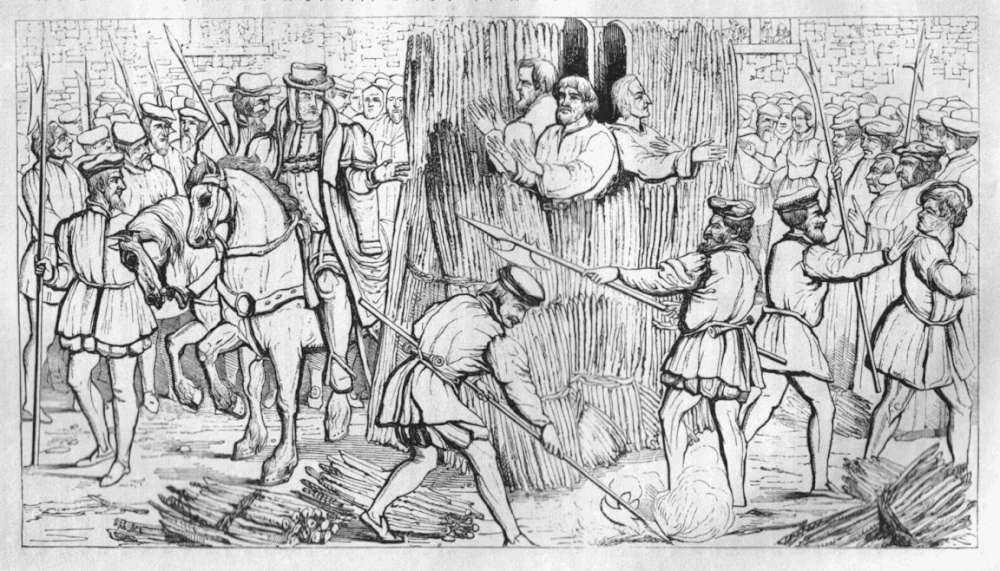
It was February of 1526 and Robert Barnes was on trial.
This was not where he expected to be. Before the age of twenty he’d joined a house of Augustinian friars and showed such great promise that he was sent first to Louvain on the continent to earn a Doctorate of Divinity and then, on his return to England, was made prior of the Augustinian friary in Cambridge and earned yet another Doctorate of Divinity. Finding in the famous university town other like-minded humanists, Robert gathered around him an intellectually and spiritually reform-minded community that met for lively debate at the White Horse Inn.
In time, they felt they had to go public with their concerns, and Robert was the obvious choice. On Christmas Eve 1525 he delivered a firebrand sermon, skewering the luxurious lifestyle of the high-ranking clergy. In no time at all accusations of heresy were flying, there’d been a student demonstration, and Robert—with a handful of others—found himself dragged to London and imprisoned.
At the end of his three-day trial before Cardinal Wolsey, Robert was forced to read aloud a recantation in front of the huge crowd, the alternative being death at the stake. He had to kneel before the bishop and beg for absolution, which was denied him until he agreed to whatever penance the bishop chose to impose. He agreed and discovered the next day what it was to be.
At an even bigger and more lavish gathering of clergy, a bishop railed from the pulpit against Robert as well as Martin Luther, made the accused men ask again for forgiveness, and then had them carry the firewood for the ceremonial burning of heretical books. Only then were the offenders absolved, at which point the crowd was granted an indulgence for having witnessed the whole affair, and Robert was sent to Fleet Prison for another six months.
When his time was up, Robert was transferred to the Augustinian friary in London for house arrest. But he evidently had not learned his lesson from the whole sorry debacle. Immediately on arrival he got involved in the sale of Tyndale Bibles—translations of the Scriptures into English—and when rumor circulated that this time Robert really was going to be burned for his troubles, he hatched a plan. He left his clothes at the edge of the Thames with a suicide note appended but actually escaped to Antwerp with the help of German merchants…

He was sure that God intended him for a life of missionary service in India. His theological studies at Göttingen and Halle, establishment of a school for poor children, oversight of a hospital—all of these were to prepare him for the trials of far-off Bengal and its people in need.
But when the call came, on his thirtieth birthday, it summoned him west, not east. German Lutherans had been migrating to the American colonies for decades, but they were like sheep without a shepherd. Would young Henry go and serve them?
He agreed—reluctantly. Three years, he said.
He stayed until his dying day…

Eighteen-year-old Arsacius Seehofer couldn’t contain his excitement when he arrived as a university tutor in Ingolstadt, Bavaria, after a stint studying in Wittenberg. For there he had learned that faith alone is sufficient for our justification! God imputes His own righteousness to us regardless of our works! God pours His Spirit into us, so we should not place our confidence in any good work of our own—yet certainly our Spirit-granted faith will produce good fruit! And since this is known only from Scripture, no one should trust any church official, not even a bishop, unless it is certain that his teaching comes from the word of God.
Those who had ears to hear knew what they were hearing. Arsacius was spouting Lutheran ideas, which had already been denounced by local preacher Georg Hauer two years prior. The ducal government was actively suppressing nascent Lutheranism by means of censorship, the seizure of Lutheran books, and the arrest of participants in private discussion groups on Reformation themes.
Therefore, no theologically intoxicated youth was going to be allowed to flout the law without consequences. In August of 1523, Arsacius’s rooms were searched and his possessions seized. On September 7, he was forced to recant before the entire university in words prepared for him: “Everything that I have read out from the writings of Philip Melanchthon in my lectures, and everything else which was spoken or written by me, and has just been read out by the notary of this university, is the most awful arch-heresy and knavery. I will never again adhere to or make use of any of it; but will betake myself, body and soul, to the Ettal monastery, not to leave the same without being commanded so to do by our gracious Lords, so that I have no desire to read or spread Lutheran ideas. May God almighty help me!”
No man came to Arsacius’s defense; it was much too dangerous.
But a woman did…

Earthquake. Volcanic eruptions. Pestilence. Famine. It could have been the four horsemen of the Apocalypse, but actually it was just Iceland at the turn of the eighteenth century.
It’s not as though Iceland has a mild or pleasant climate to begin with, but in the late 1600s and early 1700s it was worse than usual, with the result that nine thousand Icelanders starved to death between 1695 and 1702. Winter fishing claimed many men’s lives annually as well, and the unusually rough weather only increased the death toll. A smallpox epidemic in 1707 killed off a third of the population. Deforestation meant not enough firewood to heat through the brutal winters, and poor sanitation made the long enforced stay indoors that much unhealthier.
As if that weren’t bad enough, what little wealth the island did have was concentrated in the hands of a few. Landowners set exorbitant rents that peasants could never pay, leading to spiralling debt. The Danish crown imposed a trade monopoly on behalf of one of its own companies and heavily penalized those who took their business elsewhere.
Into this harsh environment Jón Vídalín was born in 1666…

Eleven-year-old Maud heard Jesus’ call to serve in Japan. For the next decade and a half she prayed and prepared for it, imagining herself walking through a rural village on the other side of the world, Bible in hand, telling “the boys and girls of Japan about Jesus their Savior.” Her sole wish was to evangelize, bringing hope of salvation to those who’d never heard the good news.
The other missionaries said no.
That was the rule “in the field”: decisions were made by a strict majority vote—democratic in nature, except for the not insignificant matter of excluding women—and the longer-term missionaries in Japan determined that what they needed was not more evangelism, but more works of mercy. Locals converts needed to see that service to the needy was part and parcel of the gospel. Besides that, the need was enormous: at the time, neither Japanese culture nor the Japanese state perceived any obligation to help the suffering. The Christians had their work cut out for them—and Maud, utterly unqualified for the task, was going to lead the way…

Johann Friedrich Oberlin is well-enough remembered to have an American college and a Japanese university named after him, not to mention countless streets in Alsace and a museum in his old home. But if any saint proves the point that no one can be a saint in isolation—that saintliness is a communal activity—it’s Oberlin. To remember this saint rightly is to bring back to remembrance the other less famous saints surrounding him as well.
It was not Oberlin but Jean-Georges Stuber who was a pioneer in the destitute parish of the Ban de la Roche, or “stone valley,” in a deep and isolated pocket of the Vosges mountains to the west of Strasbourg, France. Though these two pastors arrived more than a century after the Thirty Years’ War, the community still bore the scars of the devastating conflict and had never recovered. No road reached the village of Waldersbach or the other nearby hamlets, and no bridge crossed the fast-flowing Bruche River. The only schoolteacher was a man who had grown too old to look after his pigs anymore. The previous pastor hadn’t seen or used an actual Bible in more than twenty years. The soil was depleted, the yield of the farms was poor, and the people just barely managed not to starve.
Stuber took the post in the Ban de la Roche twice, serving a total of fourteen years, before he finally relented and accepted a more prestigious call to the St. Thomas Church in Strasbourg. He had laid the groundwork for the community’s renewal by finding a better schoolteacher, creating primers to instruct in reading, and preaching repentance and faith in Jesus Christ. But the Ban de la Roche was the last place anybody wanted to go; it was perceived more as a punishment than a parish. In the end, only one man was willing to take such a humiliating call as a worthy way to serve God: Johann Friedrich Oberlin…

It would have been gift enough to the world if Albrecht Dürer had only been an artist.
The third of eighteen children, he was apprenticed first to his goldsmith father and later to the most highly regarded painter in his hometown of Nuremberg. From both Albrecht learned a variety of skills, artistic and technical: silver point, engraving, pen, brush, gouache and watercolor, woodcuts. As a young man he toured throughout Germany, Switzerland, and the Netherlands, learning ever more in his field. After a return home for an arranged marriage to a woman named Agnes Frey—not a happy union—he set off again to see the great centers of the Renaissance in Italy: Venice, Padua, Mantua, and Cremona. The journey south made such an impact on young Albrecht that his return is credited with the birth of the Renaissance in northern Europe. When opportunity arose he returned to Italy and stayed from 1505 to 1507.
Once settled back again home in Nuremberg, Albrecht became extraordinarily productive and by the time of his death had produced “more than six dozen paintings, more than a hundred engravings, about two hundred and fifty woodcuts, more than a thousand drawings, and three printed books on geometry, fortification and the theory of human proportions.” His good friend Pirckheimer composed a epitaph befitting the high regard in which the artist was held: Quicquid Alberti Dureri mortale fuit sub hoc conditur tumulo, “Whatever was mortal of Albrecht Dürer is covered by this tomb”…

On Christmas Day 1850 Elisabeth Fedde was born on the south coast of Norway, and on Christmas Day 1873 she was reborn a deaconess at the Lovisenberg motherhouse under the leadership of Mother Katinka Guldberg, who herself had been trained at Theodor Fliedner’s motherhouse in Kaiserswerth, Germany.
Although Elisabeth was an orphaned servant girl without prospects, her destiny as a deaconess was by no means inevitable. The first time a wellwisher suggested she join the ranks of these proto-nurses, her disdainful response was, “What is that? Do you mean those women we see on the streets wearing the peculiar dress? No, thank you, I shall not join them.” And in any event, she had a sweetheart, Ole Slettebø. But despite her initial resistance, there was something about the strangely dressed women devoted to the sick and suffering that drew her.
They also brought out the best in her. Elisabeth proved herself to be extremely adept at medical care and knowledge at a time when nursing did not exist as a distinct profession and assistants to doctors, women especially, were not expected to know anything about health and hygiene. She was additionally gifted with a blessed persistence. Putting the needs of her patients first, Elisabeth would do whatever was necessary—even to the point of setting fire to lice-infested mattresses so that the hospital had no choice but to replace them—to get the sick what they needed…

How unlikely that an unbelieving student, who on principle declined to receive the Lord’s Supper for a decade, would go on to become bishop of Oslo and spend three years in solitary confinement as the cost of his public faith!
Eivind was a pastor’s son, and despite a reasonably happy upbringing in a country parish, doubts crept in and took over. The bitter factiousness of church and theology in the Norway of his youth certainly didn’t help. At his lowest point, Eivind even ripped out the page of his confirmation Bible that his mother had inscribed and burned in ceremonially. He turned to journalism, adding to it teaching, and in time, mysteriously, the wounds began to heal. Marriage to his gifted wife Kathrine helped, as did the fellowship of Christian students. Time spent reporting on World War I, on site in Germany, opened up to him the striking fact of soldiers’ faith. But it was only his father’s death in 1918 that brought about the of his confusion and pain. He knew, then, that he also had a call to serve in the ministry of the church, and he accepted it.
Eivind’s gifts for the work were immediate and enormous. He could talk to anyone, and would, whether villagers in rural Norway or prisoners at the Oslo penitentiary. Through à Nathan Söderblom he got involved in the nascent ecumenical movement and made friends across multiple national and confessional borders. He studied religious psychology and even spent time in Switzerland with Carl Jung before heading even farther north to serve as bishop of Hålogaland, the Arctic diocese populated by the Sámi and their reindeer. One of the most popular among his more than forty books was Land of Suspense, an account of his nine years there that honored both the culture and the faith of a people very different from the usual portrait of Norway.
In 1937 Eivind was summoned back south: he was appointed Bishop of Oslo and thereby the Primate of the Church of Norway. It was not an auspicious time…

Proverbs 31 may as well have been written about Katharina von Bora, the former nun who married Martin Luther and thereby became the most world-changing wife in history. But in her case, to be a wife was not simply to be attached to a famous husband. Wife was truly an office, like the office of preacher or teacher or judge: a public role with vast responsibilities demanding faultless acumen. It is hard to imagine that anyone with less resolve, grit, and personality could have pulled off the role as first lady of the Reformation and personal companion to the energetic and irascible Martin Luther.
Though more is known about Katharina than just about any other woman of her time, that still amounts to precious little. Almost none of her own thoughts are preserved; what we know about her comes to us through other people’s records. Her birthyear of 1499, for instance, was mentioned by Erasmus of all people, and her exact birthdate of January 29 doesn’t show up in any records until 1733.
Her family is known as historically important landed gentry, relatively impoverished by the time Katharina came along. Her mother died early, which may account for why Katharina spent nearly twenty years in convents, starting at the age of six as a boarder in Brehna, then five years later joining two of her aunts at Marienthron in Nimbschen, where she eventually took her vows. There she learned to read, write, and sing and started on Latin—a remarkable education in an era that considered girls’ education to be a luxury at best—as well as the business of running a household economy. No one knows what she thought of convent life except for the sheer fact that, in the end, she left it…

No human beings even tried to live in Iceland before the ninth century A.D. It is harsh, cold, rocky, and rough. Little grows beyond lichen. Sheep and horses can make do grazing, but agriculture is out of the question. Fish are abundant in the surrounding waters, but violent storms and long winter ice make it a dangerous living. Those who finally did stake out a life for themselves on this spartan rock at the north edge of the world were tough realists with no small streak of fatalism.
But extremity conveys its own benefits. In such a place, everyone has to pull together to survive. Loyalties are intense, honor is everything, and even chieftains have to respect the will of the people. Storytelling is what gets you through: it’s no wonder that Icelanders produced the oldest literature of northern Europe in their rich collection of sagas. Or that they as a people were so deeply shaped by the Passion Hymns of Hallgrímur Pétursson (1614–1674).
Just a little over a century after the first settlements in Iceland—in the year 1000—the Althing, Iceland’s council of elders, undertook a momentous decision on behalf of its people: to accept the Christian faith. Despite its coming from a hot, dry desert worlds away, the gospel gripped the people and indigenized quickly. Ísleifur, the first native bishop, was canonized in 1056 and immediately saw to the education of his clergy and translation projects.
Half a millennium later, a student named Oddur Gottskálksson learned of Luther’s teachings while studying abroad, prayed to the Lord to show him the right way, and upon receiving his answer pursued the Reformation course. He undertook the first translation of the New Testament into Icelandic, printed in 1540, which in turn led to the first complete Icelandic Bible in 1584. These two sparked a fresh flowering of literature after several centuries of dormancy following the era of the sagas. The Reformation’s commitment to education coincided neatly with Icelandic values and led to widespread literacy, and the new permission for pastors to marry meant that the clergy, now having families of their own, shared personally in the people’s struggle against poverty and for survival.
Nevertheless, the Lutheran interpretation of the gospel didn’t really take hold in the lives of the Icelandic people until the seventeenth century under the guidance of Hallgrímur…

An exceedingly rare case of a saint of both the lefthand and righthand kingdoms: civic wonderworker and mystic alike. Proposed date of commemoration: September 18.
* * *
“For all that has been—Thanks! To all that shall be—Yes!”
With these words Dag Hammarskjöld greeted the new year of 1953 in the private journal that later became known to the world as Markings. They are not the words one would have expected from him at this point in his life. The years had been painful. He was lonely, deeply lonely. His thoughts recurred to duty and not infrequently to sacrifice. He wondered if life held any meeting at all. Suicide was a temptation all the way until 1952 when, it seems, he made the final decision against it: “No! Death must be your final gift to life, not an act of treachery against it.”
Those words were prophetic. His death would be a gift to life, but taken by another’s treachery, not his own…

On that day in March 1948 there was another Hungarian with Lajos Ordass (1901–1978) on the plane to Zürich, a senior of the Methodist church. Visibly upset, he asked Lajos for a private meeting once they’d landed. Upon their safe arrival in Switzerland, the man told his story: how he’d been arrested in Budapest, interrogated about his overseas contacts—and asked what he knew about Lajos. He’d only been allowed to leave the country on the condition that he spy on Lajos during the trip, but in defiance of government pressure he turned over to Lajos the list of questions he’d been instructed to ask. He only dared to tell Lajos these things at all because he was planning to escape, never to return to Hungary.
Despite the warning Lajos returned home, bracing himself for the onslaught…

“With only one life to live, why throw it away by going to India?” a friend once asked Anna Sarah Kugler (1856–1930). Deliberately adopting a turn of phrase from her new country, the doctor replied, “It was written on her forehead by the pen of Brahma,” which is to say: she was called to it by God and dared not disobey.
In the late nineteenth-century America, it was uncommon for women to be doctors, much less missionary doctors forsaking their homeland to serve on the other side of the world. But Anna had known that was what she would do ever since as a little girl she first heard a missionary to India speak about the work there…

The Oromo people of western Ethiopia received the gospel from freed slaves.
It wasn’t like foreign missionaries hadn’t been trying. They had, for years. One setback after another prevented them from reaching the enormous tribe whose language is the second-largest indigenous one in use in Africa. And it certainly didn’t help that the Amhara emperors and their vassal kings were in the process of conquering Oromia at the very same time.
But just as Joseph’s sale into slavery ultimately meant the salvation of his people (Genesis 37), so did the enslavement of many Oromos. One particular Oromo boy named Hika, whose name prophetically meant “translator,” lost his father and therefore his protection at the age of four, whereupon he was kidnapped by a slaver. Over the next dozen years, he was stolen twice and sold four times, though one master was kind enough that the boy willingly took the man’s surname Nesib as his own.
His horrific existence ended in 1870 when a Swiss explorer and diplomat named Werner Münzinger bought him and turned him over to the care of the Swedish Evangelical Mission, run by Pastor Bengt Peter Lundahl in Massawa on the Red Sea coast in present-day Eritrea. No longer a slave but a student, he threw himself wholeheartedly into his studies and the faith of his liberators. At his baptism on Easter day in 1872, he took the Christian name Onesimos, after the runaway slave that St. Paul had liberated and sent home free to be reconciled to his master Philemon.
Onesimos found his new community among not only the Swedish missionaries in Massawa but also many other freed Oromo slaves. Despite having left his homeland at such an early age, his one passion was to return and share the gospel with his own people…

Hey, remember my Lutheran saints series? It’s been awhile, for which my apologies. But the long absence of this series is not due to neglect of the saints—far from it. In fact, I have taken a detour from writing up hagiographies for an eventual book of Lutheran saints to do the theological background work that I always knew I’d have to do as well.
This scholarly sidestep is not chiefly due to anticipated hostility from fellow Lutherans toward the very notion of a Lutheran sanctorale. If anything, I’d say my church community is positively longing for better acquaintance with its own saints. But there is certainly an ongoing sense that it is vaguely illegitimate. Good Lutherans that we are, we want solid theological arguments before plowing ahead…