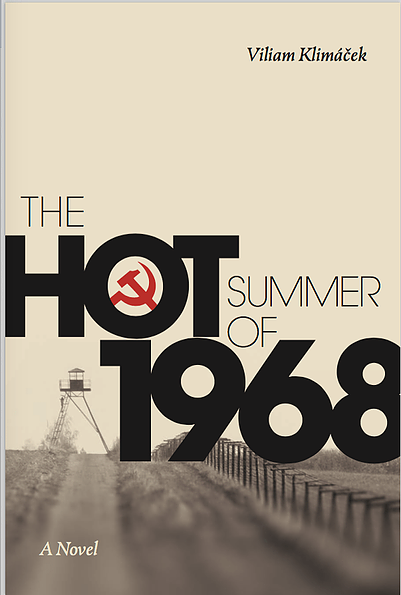
I little expected to find another five-star novel so soon after It Happened on the First of September. But not only does The Hot Summer of 1968 fully deserve this highest of ratings, it’s practically a sequel to the other novel, despite being by another author. I take this as evidence that the oft-overlooked Slovakia has a history and culture rich enough to repay ample fictional exploration. The more, the better! …
Read moreSlovak Novels in English #35: Bellevue

Ivana Dobrakovová, Bellevue, trans. Julia and Peter Sherwood (London: Jantar, 2019), 220 pp.
Of all the Slovak novels in English I’ve reviewed so far, the assignment of three stars to this one is the most arbitrary of any rating I’ve given. It’s a compromise, actually. If I were to rate the novel based on its accomplishment of its intended goal, it certainly deserves five stars. If I were to rate it on the pleasure I took in reading it, it would get one star.
But that can hardly count as a legitimate a criticism of a book that maps out the degeneration of a mind into madness…
Read moreMystagogical Realism
I can remember the first time someone told me about Gabriel García Marquez’s One Hundred Years of Solitude. “It’s magical realism,” he told me. “What’s that mean?” I asked. The answer: “There’s a priest who levitates when he drinks hot chocolate.”
That was enough for me. I was hooked. You can guesstimate when this conversation took place based on the fact that I ended up reading the book in my private berth on an Amtrak traversing halfway across the country because all the flights were shut down due to a terrorist attack on the Twin Towers.
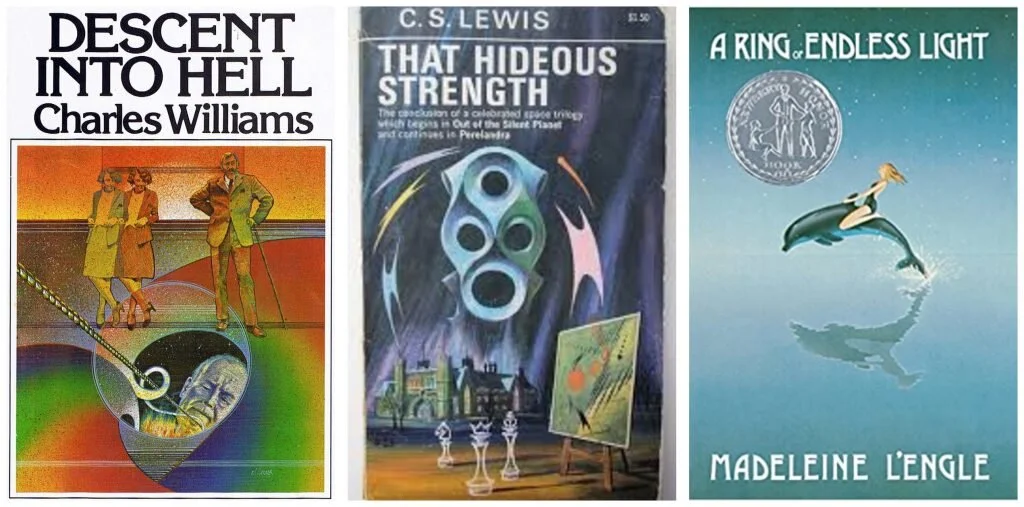
Marquez’s fiction has a distinct flavor all its own (of hot chocolate?), but it wasn’t so far off from other books I’d known and loved but had no collective term for. Top of the list was C. S. Lewis’s That Hideous Strength.
I did not start out loving this book, probably because I was too young the first time I read it. But more importantly because the trilogy structure inadvertently misled me. Out of the Silent Planet takes place on Mars! Perelandra takes place on Venus! That Hideous Strength takes place on… Earth?! I was bitterly disappointed, that first time through.
But subsequent rereadings shifted its status from my least favorite of the trilogy to my very favorite of all of Lewis’s works. It spoke to the intuition that there is much of a wondrous nature even on this Earth. The problem is not wonder’s absence but my (and our) perception thereof…
Read moreTransgenre Theology

Early Lutheran transgenre theology: depicting the distinction between law and gospel visually.
You may have misread the title of this post. Take a second look just to be sure.
I’m fascinated by and obsessed with genre, which is not necessarily the most flattering moniker in the literary world.
“Genre fiction” is dismissed as formulaic, literarily subpar, and morally questionable to boot. Passive tools of the powers-that-be drug themselves with one escapist fantasy after another, whether it’s romance, Western, or sci-fi—or so the accusation goes.
Ursula K. LeGuin taught me to reverse my suspicion toward such suspicion of genre fiction, and enough disappointed dabblings in literary fiction have taught me that there’s more than one way to drug a populace. It’s the sniffy writers of beautiful sentences devoid of meaning or plot who are most likely to claim that their work can’t be classified; it’s beyond genre, so they say.
While I do like to read all kinds of things, I’m not especially devoted to any one genre. If it’s a good story, well told and well written, I’m game. The real reason I’ve become a genre devotee is because of the epistemology it unlocked for me…
Read moreCurated Catechesis

Catechesis is dead. Long live catechesis.
I’ll leave it to someone else to trace out how, exactly, catechesis died in the churches. I can at best hazard a few guesses based on intuition and anecdotes.
For example:
A bad habit of anti-intellectualism made adults turn on the rote education they received as children.
Or, a habit of over-intellectualism made clergy and professors invest more energy in reconciling with science and sociology than covering doctrinal and biblical basics.
Stifling apologetics caused distrust even of modest and ad hoc apologetics.
Claims for ultimate truth came to seem too exclusionary.
Congregational disinclination to pay for a pastor who continued to read and learn.
Pastoral disinclination to keep on growing.
So much Christendom as to make the faith seem self-evident, but not enough Christendom actually to sustain it.
Soccer practice and SAT cram sessions.
TV, internet, smartphones.
Any and all of the above.
At some point, it doesn’t even matter what caused it, only how to reverse it…
Read moreI Am a Brave Bridge: The Complete Prologue!
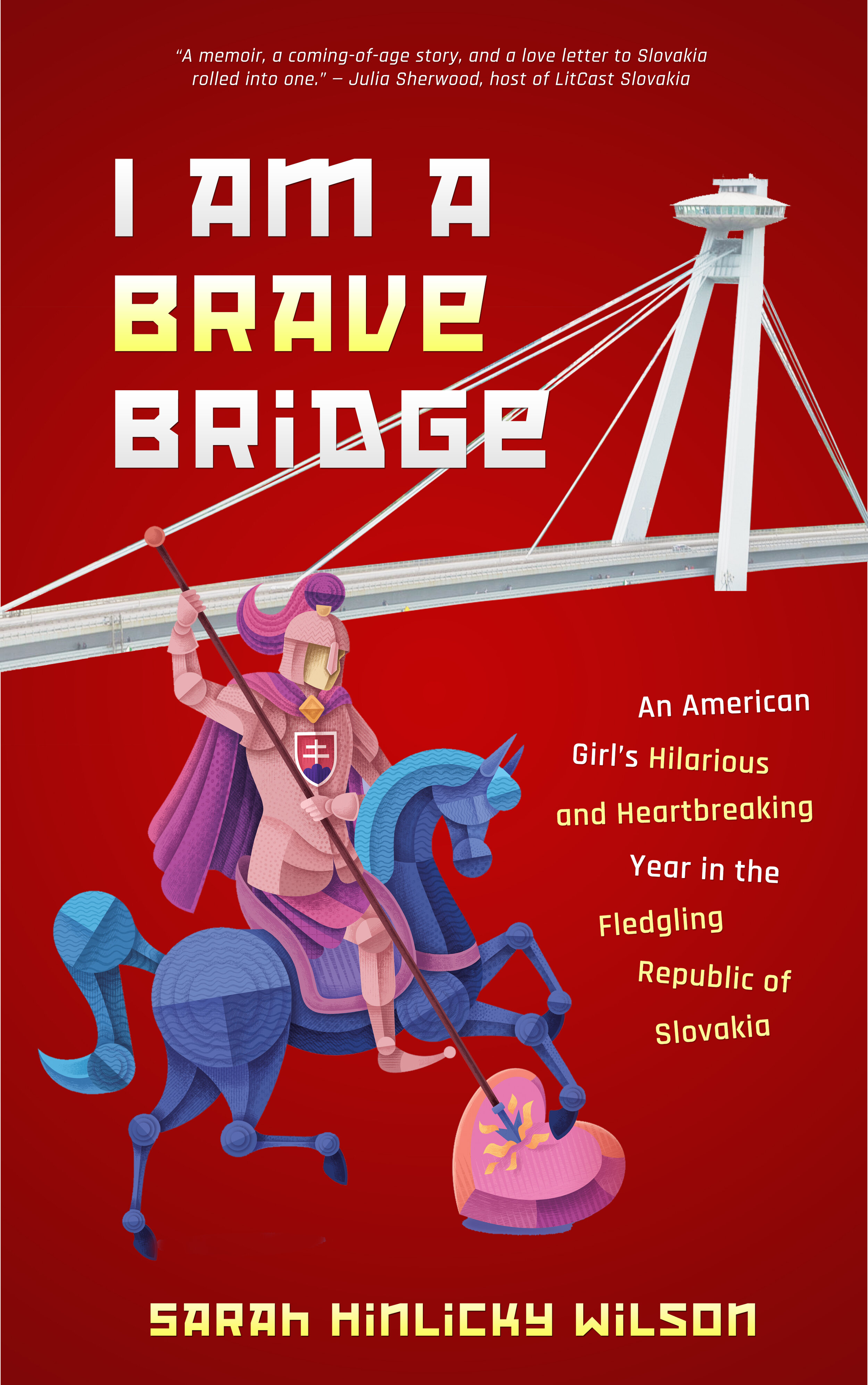
Click on the cover to order your copy from Amazon!
I missed Czechoslovakia by six days.
It had been an odd sort of companion throughout my childhood, like an invisible mirror or rumored cousin, never quite real enough to manifest, never quite imaginary enough to vanish.
There was reason for its reticence, of course. It was communist, though poor little Czechoslovakia couldn’t really be blamed for that. Whenever I visited the red and gray farmhouse in upstate New York cobbled together by my grandparents’ meager construction skills, I would spin their globe, swiping the Atlantic Ocean out of sight, to locate the inverted circumflex amidst a crazy-quilt of countries small enough to be states. Surely Czechoslovakia had the most wonderful name of them all. Fourteen letters, beginning with that peerless Cz cluster, hinged in the middle by a modest but muscular o flicking upward the long fishtail of the remainder. The little orange strip, topologically ridged to represent the Carpathians, could barely accommodate its unwieldy moniker, in marked and modest contrast to the vast swath only a thumbprint’s width away, which fittingly named itself with a four-letter word: U.S.S.R.
I knew things about Czechoslovakia that other people didn’t, and not only how to spell it. Czechoslovakia, like Gaul, was divided into three parts: Bohemia, Moravia, and Slovakia. I assumed they were ordered according to the principle of save-the-best-for-last. My people were not Bohemians or Moravians. We were Slovaks.
I also knew that the pseudo-word “Slovakian”—usurper, pretender, and offense against eye and ear—was our private shibboleth, the unerring indicator of an outsider. It was anathema to us Slovaks; no one on the inside ever, ever said it, The New York Times notwithstanding. Ditto the equally opprobrious “Czechoslovakian” as a term for a nonexistent language.
I knew, moreover, that it made no nevermind that three generations of us had never actually been there. American citizenship was a mere epiphenomenon, a fact that my classmates, most of whom hadn’t the faintest idea of their own ethnic heritage, seemed unable to grasp. Whereas I knew that if sentimentality for the lost motherland gripped the church ladies in my grandfather’s Slovak congregation, the sure result was to be cabbage rolls, boiled with an inch of their lives. Plus ziti. Contradictions were allowed.
There was something else I knew, of which Czechoslovakia was but one of several echoes reverberating back to me from afar: I knew how always to be homesick for somewhere else…
Read moreI Am a Brave Bridge: Cover Reveal!
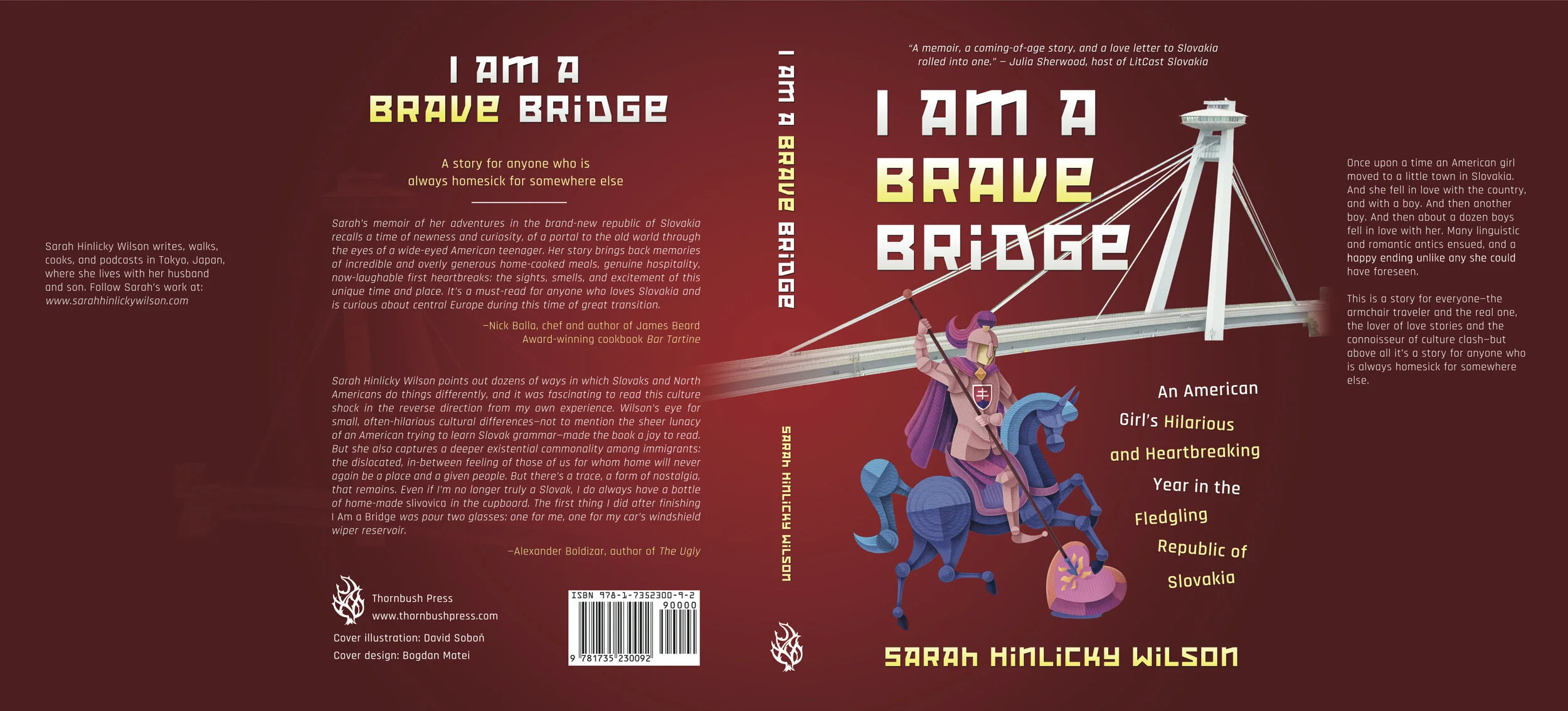
I’ve been working on this book for five years, gone through drafts and beta readers and research and “killing my darlings,” and you’d think that would be enough. But I think any author will tell you that nothing makes it real like seeing the cover!
The basic concept was mine. I wanted an image of St. George in honor of the starring town of Svätý Jur (St. George in Slovak), but I wanted him spearing not a dragon but a heart—namely, mine. And in the background I wanted the SNP Bridge, which I like to think of as the Eiffel Tower of Bratislava, at least of its iconic status if not quite the same level of architectural distinction. Strictly speaking, the title doesn’t refer to this bridge, but I must say it’s pretty handy that Bratislava boasts such a distinctive bridge to make for a great visual tie-in!
However, my skill set definitely does not extend to the execution of visual design, so I found two great artists to make the dream a reality…
Read moreCooking at the Crossroads

Just about a month away now from the launch of I Am a Brave Bridge, my memoir with recipes of a year in Slovakia 1993–1994, I thought it was time to give a little love to an unjustly neglected cuisine at the four corners of a defunct empire.
The Cooking of Vienna’s Empire is how the Time-Life “Foods of the World” characterizes it and accordingly entitles that entry in the renowned series. I imagine the Hungarian half of the Austro-Hungarian Empire would be rather irritated by their absence from this name, but as usual, Slovaks have more cause to complain: author Joseph Wechsberg fails to include a single recipe attributed to Slovakia (even “Liptauer Cheese,” the German name for a spread from the Liptov region of Slovakia), presumably assuming—as Czechs are wont to do—that Slovak is a subset of Czech.
For all that, it’s a marvelous cookbook and a good place to start if, as is generally the case in the English-speaking world, central Europe is kind of a blank on your mental map…
Read moreSlovak Novels in English #34: Martinko

This is the fifth novel by Royová that I’m reviewing, following upon Sunshine Country, Three Comrades, Only a Servant, and Kept by a Mighty Hand. But, as it turns out, Martinko is the very first book she wrote!
It was published originally in 1893 until the title Bez Boha na svete, or “Without God in the World,” though the protagonist does bear the name Martinko. Royová wrote it in response to a general challenge for someone to produce some kind of children’s literature “for God.” It now stands as the single most translated work of Slovak literature—the introduction to my copy notes that it has appeared in innumerable German editions as well as Hungarian and Russian.
So that’s pretty cool. However, Royová went on to write nearly seventy novels, and frankly it’s pretty obvious that this one is her first. I’ve spoken warmly of the emotional and spiritual complexity in some of her other works, but this one is so pious as to border on the saccharine. A poor little orphan boy, kept alive but not well-loved by the townspeople, yearns for God, finds a Bible and some mentors, inadvertently re-enacts certain aspects of Jesus’ ministry, and dies tragically from injuries gained while saving a lost sheep, young but saved and an inspiration to the half-hearted Christians all around him. The christological allusions are heavy-handed, at best.
But as so often is the case with Slovak lit translated before the Velvet Revolution, the circumstances of its translation proved to be the really interesting facet of this story…
Read moreMemoirs with Recipes

Now that I am—finally!—counting down the days and not the years until the launch of I Am a Brave Bridge: An American Girl’s Hilarious and Heartbreaking Year in the Fledgling Republic of Slovakia, I have found myself more and more curious about the other contenders in my subgenre: the memoir with recipes.
It came as no surprise that memoirs with recipes lean heavily toward the crosscultural and international. Nothing evokes the reality of having a foot in more than one reality than the different, even conflicting tastes you develop along the way. Being an international person means always being hungry for something you can’t get…
Read more